How Much Is Stamp Duty for a First-Time Buyer?
If you are buying your first home, the amount of stamp duty you pay depends on the price and on whether every buyer is a first-time buyer. Use the Joint First-Time Buyer Stamp Duty Calculator to work out your exact bill in seconds.
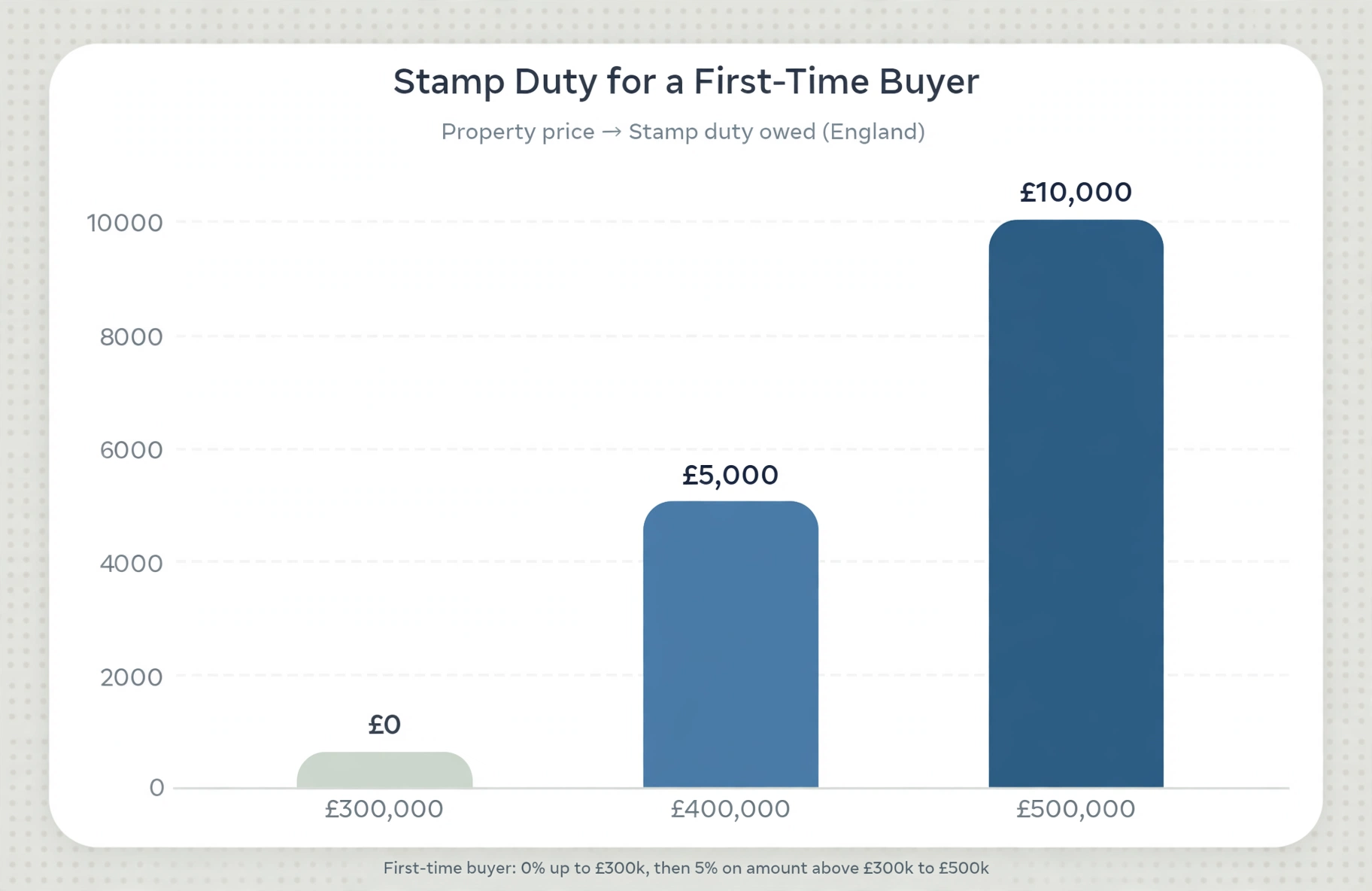
Direct answer: A first-time buyer in England or Northern Ireland pays no stamp duty up to £300,000, then 5% on the part of the price from £300,001 to £500,000, according to GOV.UK and HMRC guidance. On a £400,000 first home that means a £5,000 bill, a figure that follows from the GOV.UK rates.
Key Takeaways
The short version: no stamp duty up to £300,000, 5% on the slice up to £500,000, and normal rates above £500,000.
- First-time buyers pay 0% up to £300,000 and 5% from £300,001 to £500,000 in England and Northern Ireland.
- A £400,000 first home costs £5,000 in stamp duty. A £500,000 first home costs £10,000.
- Above £500,000 the relief is lost on the whole price, not just on the part above £500,000.
- If you buy jointly, every buyer must be a first-time buyer or the relief is lost entirely.
- This guide covers completions on or after 1 April 2025.
How much stamp duty does a first-time buyer pay at common prices?
A first-time buyer pays £0 on a £300,000 home, £5,000 on a £400,000 home, £7,500 on a £450,000 home and £10,000 on a £500,000 home in England or Northern Ireland.
The maths is simple. Take the price, subtract £300,000, and take 5% of what is left, as long as the price is £500,000 or less. On a £400,000 home, £400,000 minus £300,000 is £100,000, and 5% of £100,000 is £5,000. On a £450,000 home, £450,000 minus £300,000 is £150,000, and 5% of £150,000 is £7,500. The rates are the post-1-April-2025 first-time buyer relief bands published by GOV.UK and HMRC.
| Purchase price | Stamp duty for a first-time buyer |
|---|---|
| £300,000 | £0 |
| £350,000 | £2,500 |
| £400,000 | £5,000 |
| £450,000 | £7,500 |
| £500,000 | £10,000 |
What is first-time buyers relief?
First-time buyers relief is the lower stamp duty rate for people buying their first home in England or Northern Ireland: 0% up to £300,000 and 5% from £300,001 to £500,000, according to GOV.UK and HMRC guidance.
Stamp Duty Land Tax, or SDLT, is the tax paid when you buy property in England or Northern Ireland. The standard rates start at 0% up to £125,000, then 2% to £250,000, 5% to £925,000, 10% to £1,500,000 and 12% above that. First-time buyers relief replaces those standard rates with the lower 0% and 5% bands, but only up to a £500,000 purchase price. To count as a first-time buyer you must never have owned a home before, anywhere in the world, and the home must be your main residence. The joint rule is strict: if you buy with someone else, every buyer must be a first-time buyer or the relief is lost entirely. That rule is published in the GOV.UK and HMRC guidance.
What happens if the price is above £500,000?
Above £500,000 the first-time buyer relief is lost on the whole price, and the normal standard rates apply from £0. A £510,000 first home costs £15,500 in stamp duty, not £10,500.
This is the cliff rule, and it catches people out. The wrong reading is to keep the relief up to £500,000 (£10,000) and add only 5% on the £10,000 above it, which gives £10,500. That is wrong. Once the price passes £500,000, the standard rates apply to the whole price: 0% on the first £125,000, 2% on the next £125,000 (£2,500), and 5% on the remaining £260,000 (£13,000), giving £15,500 in total. The £15,500 figure follows from the GOV.UK standard bands: 0% on the first £125,000, 2% on the next £125,000 (£2,500) and 5% on the remaining £260,000 (£13,000). The lesson is plain: a £10,000 rise in price from £500,000 to £510,000 adds £5,500 to the stamp duty bill.
How much is stamp duty for a first-time buyer in Scotland or Wales?
Scotland and Wales use different taxes with their own bands, which are set out below, so the England and Northern Ireland figures in the rest of this post do not apply there.
In Scotland the tax is Land and Buildings Transaction Tax (LBTT). Revenue Scotland sets the residential bands at 0% up to £145,000, 2% from £145,001 to £250,000, 5% from £250,001 to £325,000, 10% from £325,001 to £750,000 and 12% above £750,000, in force since 1 April 2021 and held unchanged for 2026 to 2027. First-time buyer relief raises the nil-rate band to £175,000, which saves up to £600. In Wales the tax is Land Transaction Tax (LTT). The Welsh Revenue Authority main residential bands are 0% up to £225,000, 6% from £225,001 to £400,000, 7.5% from £400,001 to £750,000, 10% from £750,001 to £1,500,000 and 12% above £1,500,000, and GOV.WALES states there is no first-time buyers relief in Wales, so a first-time buyer in Wales pays the same main rates as everyone else. The figures in the rest of this post are for England and Northern Ireland only.
Frequently asked questions
How much is stamp duty for a first-time buyer?
A first-time buyer in England or Northern Ireland pays no stamp duty up to £300,000, then 5% on the part of the price from £300,001 to £500,000. On a £400,000 first home that means a £5,000 bill.
What is first-time buyers relief?
First-time buyers relief is the lower stamp duty rate for people buying their first home in England or Northern Ireland: 0% up to £300,000 and 5% from £300,001 to £500,000.
What happens if the price is above £500,000?
Above £500,000 the relief is lost on the whole price and the normal standard rates apply from £0. A £510,000 first home costs £15,500 in stamp duty, not £10,500.
How to Use the Joint First-Time Buyer Stamp Duty Calculator
Run your own price through the calculator to see the exact bill in seconds: type in the price, mark each buyer as a first-time buyer or not, and the result appears at once with a band-by-band breakdown.
The Joint First-Time Buyer Stamp Duty Calculator costs nothing, answers at once and asks for no email address. It gives the total bill, the tax on each band so the maths is visible, and the effective rate, which is the total bill divided by the price. For a joint purchase it puts the bill with relief next to the bill without relief, so the cost of one previous owner is right in front of you. Quick presets at £300,000, £400,000, £450,000 and £500,000 let you watch the bill jump at the £300,000 and £500,000 thresholds. If you are buying with a partner, read Do First-Time Buyers Pay Stamp Duty Over £300,000? next, because the £300,000 threshold is where your bill starts.
Sources
Every figure in this post comes from the official sources listed below.
- GOV.UK and HMRC, residential property rates and first-time buyers relief (post-1-April-2025 bands, published by GOV.UK and HMRC).
- Revenue Scotland, LBTT residential property rates and bands and first-time buyer relief (0% to £145,000, 2% to £250,000, 5% to £325,000, 10% to £750,000, 12% above; first-time buyer nil-rate band £175,000, saving up to £600).
- Welsh Revenue Authority and GOV.WALES, Land Transaction Tax rates and bands (0% to £225,000, 6% to £400,000, 7.5% to £750,000, 10% to £1,500,000, 12% above; no first-time buyers relief in Wales).
Disclaimer: Estimates only, not financial advice. Check the figures against HMRC guidance or with a qualified tax adviser before you act on them.
Last verified: 16 November 2026