TSP Loan vs Withdrawal Calculator: Find the Cheaper Choice in 2 Minutes
If you search for a TSP loan vs withdrawal calculator, you will find threads and tables, but no calculator that runs the comparison in dollars for your amount. This post shows the comparison worked out in dollars, and our TSP loan calculator is the tool that does it for your own figures.
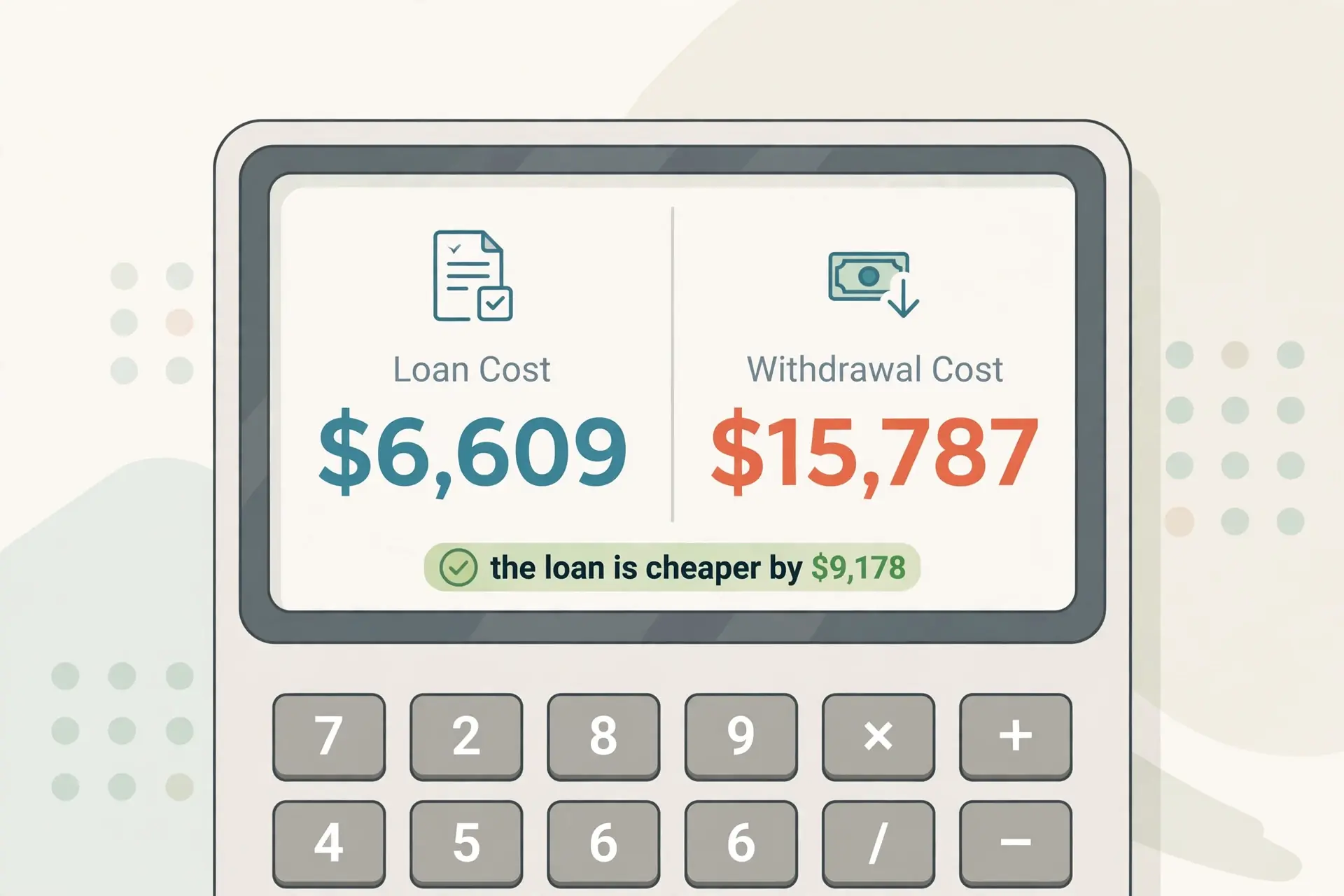
Direct answer: No calculator runs this comparison for your amount, so our comparator fills that gap: on $20,000 over 5 years at the G Fund rate of 5.375% (tsp.gov, November 2026), the loan costs $6,609 and the withdrawal costs $15,787, so the loan is cheaper by $9,178.
Key Takeaways
- The two dedicated loan calculators, FedTools and TSPFolio, compare the loan to other borrowing or to investing, never to a withdrawal.
- The comparator is the differentiator: tax plus 10% penalty plus lost growth on the withdrawal side, next to the loan side, on the same dollar amount.
- The worked example below uses two labelled assumptions: a 22% federal bracket and an 8% market return.
Why is there no loan vs withdrawal calculator on Google?
No loan vs withdrawal calculator was found for this search. FedTools has strong opportunity cost framing but no loan vs withdrawal comparison and no withdrawal tax or penalty math anywhere. TSPFolio compares the loan to other borrowing, a personal loan, a car loan and a credit card, not to a withdrawal. The tsp.gov pages for this search contain no calculator at all. A table is not a calculation. That is the gap this tool was built to fill.
What does the comparator calculate?
The comparator calculates both sides on the same dollar amount. On the loan side it shows the payment per paycheck and per month, the fee, the total repaid, the interest paid back to yourself, the cash you receive, the net opportunity cost, and the payoff date. On the withdrawal side it shows the federal tax due, the 10% early withdrawal penalty if you are under 59 and a half, the state tax due, the cash actually received, the permanent balance reduction, and the lost future growth. The verdict line at the top reads “The loan costs you $X. The withdrawal costs you $Y.”
The worked example: $20,000, 5 years, 5.375%
Borrow $20,000 as a general purpose loan, 5 years, G Fund rate 5.375%, biweekly pay (26 paychecks a year), $50 fee. The payment is $175.60 per paycheck, 130 payments, paid off about November 2031. Cash you receive is $19,950 after the $50 fee. Total repaid is $22,828, of which $2,828 is interest paid back to yourself. Foregone growth at the 8% assumed market return is $9,387, so the net opportunity cost is $9,387 minus $2,828, which is $6,559. Loan total cost is $6,559 plus the $50 fee, which is $6,609. That $6,609 is a $50 fee plus $9,387 of foregone growth, minus $2,828 of interest paid back to yourself, where the $9,387 is 8% growth on $20,000 over 5 years and the $2,828 is the interest at 5.375% over 5 years.
Take the same $20,000 as an early withdrawal, age under 59 and a half, federal bracket 22% (an example assumption). Federal income tax is $4,400. The 10% early withdrawal penalty is $2,000. Cash you actually receive is $13,600. The permanent balance reduction is $20,000. Lost future growth is $9,387. Withdrawal total cost is $4,400 plus $2,000 plus $9,387, which is $15,787. The loan costs you $6,609. The withdrawal costs you $15,787. On the same $20,000, the loan is cheaper by $9,178.
Frequently asked questions
Short answers to the questions people ask most are below.
- How do I calculate how much a withdrawal will cost me, tax plus penalty? Add three things: federal income tax at your bracket, the 10% early withdrawal penalty if you are under 59 and a half, and the lost future growth on the withdrawn amount. On $20,000 at a 22% bracket that is $4,400 plus $2,000 plus $9,387 of lost growth at an 8% assumed return, a total of $15,787.
- Is a TSP loan better than a hardship withdrawal? A loan is usually cheaper than a hardship withdrawal when you qualify for both, because a withdrawal is permanent, taxed as ordinary income, and possibly penalized, while a loan is repaid to your own account. The comparator shows both on the same dollar amount.
- How is the interest calculated on a TSP loan? TSP loan interest is charged at the G Fund rate from the month before the loan request, fixed for the life of the loan, and the interest paid goes back into your own TSP account, according to tsp.gov. The rate was 5.375% as of November 2026.
How to use the TSP loan calculator
Use the TSP loan calculator to run this comparison on your own amount. Enter the amount you need, your TSP balance, the loan type, the term, the G Fund rate (default 5.375%, November 2026), your pay frequency, your age, and your federal and state tax brackets. The result appears instantly as you type, with no Calculate click and no email gate. The benefits are simple: the comparator is the default view, so both sides are on screen from the first keystroke; the “what if” sliders let you drag the amount, the term and the market return and watch the verdict move; and the max loan three test check shows the smallest of your three limits as your maximum. If you want the tax detail behind the withdrawal side, read TSP Loan vs Withdrawal Taxes.
Sources
- tsp.gov, TSP Loans page, last updated 14 September 2026: rate 5.375% as of November 2026, fees, terms, limits.
- IRS, Topic No. 558: 10% additional tax on early withdrawals before age 59 and a half, unless an exception applies.
Disclaimer: Estimates only, not financial advice. Verify with tsp.gov guidance, IRS guidance, or a qualified tax adviser.
Last verified: 16 November 2026