How Much Do You Get Penalized for Taking Money Out of Your 401(k)?
Taking money out of a 401(k) early feels simple, until the bill arrives. The penalty is only one part of the cost, and most people forget the tax that comes with it. Use the 401(k) Early Withdrawal Calculator to see both numbers on your own amount before you decide.
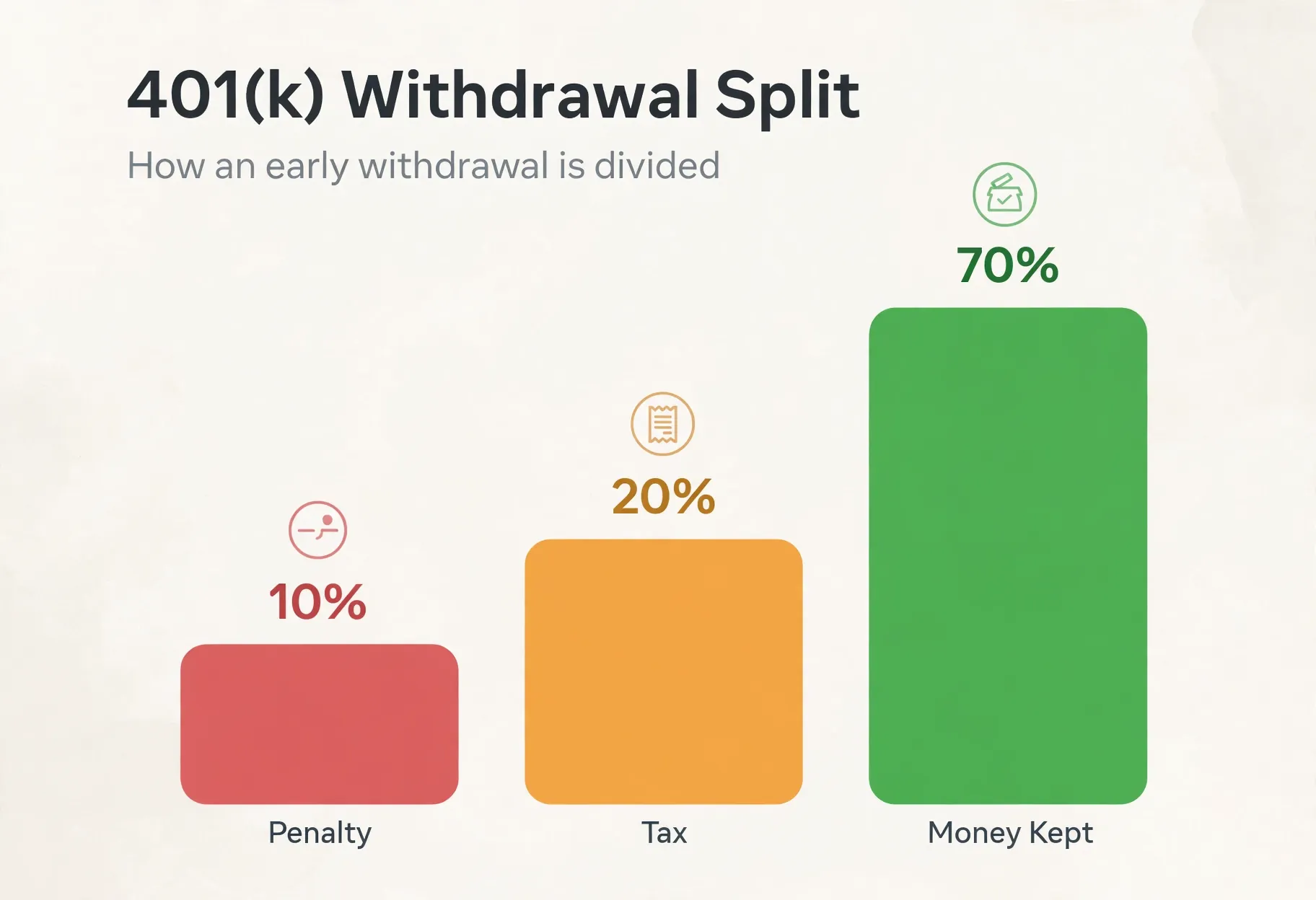
Direct answer: If you take money from a traditional 401(k) before age 59 and one half, the IRS charges a 10% additional tax on the withdrawal, on top of ordinary income tax, according to IRS retirement plan distribution guidance. A $10,000 early withdrawal therefore carries a $1,000 penalty, plus the income tax on the $10,000, unless an exception applies.
Key Takeaways
The short version: the 10% penalty is real, it sits on top of income tax, and the total bill is bigger than the penalty alone.
- The 10% additional tax applies to early withdrawals before age 59 and one half, according to the IRS.
- Income tax applies too, because a traditional 401(k) withdrawal counts as ordinary income, according to the IRS.
- A $10,000 withdrawal means a $1,000 penalty, before any tax is added.
- Some exceptions can remove the penalty, but the income tax usually still applies.
How much is the penalty, exactly?
The penalty is 10% of the amount you withdraw early, according to IRS retirement plan distribution guidance.
The 10% is called an additional tax. It is charged under IRC 72(t), the section of the Internal Revenue Code that sets the 10% additional tax on early withdrawals and lists the exceptions, and it is added to the income tax you already owe on the withdrawal. That is why the total cost surprises people.
Your age is what decides it. Before age 59 and one half, the penalty usually applies. At or after that age, it usually does not. Your plan may also have its own rules, so check your plan documents too.
| Withdrawal amount | 10% penalty |
|---|---|
| $5,000 | $500 |
| $10,000 | $1,000 |
| $20,000 | $2,000 |
| $50,000 | $5,000 |
The table shows the penalty only. Income tax is extra, and it depends on your tax bracket.
What else do you pay on top of the penalty?
You also pay ordinary income tax on the withdrawal, because the money was never taxed when it went in.
A traditional 401(k) holds pre-tax money. When you take it out, it becomes taxable income in that year. It can even push you into a higher tax bracket, which raises the tax on the withdrawal itself.
As an illustration, take a $20,000 withdrawal at age 45, Single, with a $60,000 salary. The 10% penalty is $2,000, and at a 22% federal marginal rate the federal tax is $4,400, leaving $13,600. The 22% rate is the 2026 marginal rate for that income under IRS Rev. Proc. 2025-32, so treat the example as an illustration, not as your rate.
Does the penalty ever not apply?
Yes, some reasons can remove the 10% penalty, but each one must be checked against IRS rules before you rely on it.
The reasons people ask about most include separation from service at 55 or later, disability, death, hardship, substantially equal periodic payments, and the SECURE 2.0 exceptions. The SECURE 2.0 exception amounts are the IRS figures: emergency $1,000 per year, domestic abuse the lesser of $10,000 or 50% of your vested balance ($10,500 for 2026), birth or adoption up to $5,000 per child, disaster up to $22,000, and terminal illness with no dollar cap, according to the IRS exceptions table and IRS Notice 2024-55.
Even when the penalty is removed, the income tax usually stays. That is the part people miss. An exception saves the 10%, not the whole bill.
What does the withdrawal cost in lost growth?
The hidden cost is the growth the money would have earned if it had stayed invested until retirement.
In the same example, the $20,000 taken out at age 45 would have grown to $64,143 by age 65 at a 6% return, so the growth lost was $44,143 over 20 years. The 6% return is an assumption, not an IRS figure, but the point stands at any return: early money costs far more than the penalty alone.
This is why a small withdrawal early in your career can cost far more than the same withdrawal near retirement. Time is doing the damage, not just the tax.
Frequently asked questions
Short answers to the questions readers ask most about the 10% penalty.
How much is the 401(k) early withdrawal penalty?
The penalty is 10% of the amount you withdraw before age 59 and one half, according to IRS retirement plan distribution guidance. It is an additional tax on top of ordinary income tax. Some exceptions can remove it, but the income tax usually still applies.
Is the penalty the same as the tax?
No. The 10% penalty is extra, and the income tax is separate. As an illustration, a $20,000 withdrawal carried a $2,000 penalty and $4,400 of federal tax, leaving $13,600. Your own tax depends on your bracket.
Can I avoid the 10% penalty?
Sometimes. Separation from service at 55 or later, disability, hardship and the SECURE 2.0 exceptions are the reasons people ask about most. The SECURE 2.0 amounts are the IRS figures: emergency $1,000 per year, domestic abuse the lesser of $10,000 or 50% of your vested balance ($10,500 for 2026), birth or adoption up to $5,000 per child, disaster up to $22,000, and terminal illness with no dollar cap, according to the IRS exceptions table.
How to use the 401(k) early withdrawal calculator
Start with the penalty on your own amount, using the free 401(k) early withdrawal calculator, with no email needed.
Enter the withdrawal, your age and your tax details, and the calculator shows the 10% penalty, the tax and the lost growth at once.
Try $10,000 first, then try $5,000, and compare the two results side by side to see how fast the cost falls when the amount shrinks. The difference is often enough to change the decision.
Related reading in this cluster: How Much Is Taxed on a 401(k) Early Withdrawal?.
Disclaimer: This post is for education only. All figures are estimates only, not financial advice. Tax rules change, and your plan has its own rules, so check the IRS guidance or talk to a qualified tax adviser before you withdraw.
Sources
These are the sources used in this post.
- IRS retirement plan distribution guidance.
- 26 USC 72(t), the Internal Revenue Code section that sets the 10% additional tax on early distributions and lists its exceptions.
- IRS Retirement Topics, Exceptions to Tax on Early Distributions (SECURE 2.0 exception amounts).
Last verified: 16 November 2026